Hermes Agent has a clear public identity: a self-improving AI agent with a learning loop, skills, memory, messaging, cron, terminal backends, and broad platform reach. If your goal is an agent that gets better through use and can live across CLI, chat, and cloud-like environments, Hermes Agent belongs on your shortlist.
The alternative question is different: do you want the agent to improve itself, or do you want every piece of the work to become visible in a workspace you operate? The best answer depends on your tolerance for autonomous learning, your need for reviewable state, and how much of the work should become structured artifacts.
Self-improving agent or governed workspace
A self-improving agent can be powerful because it can turn experience into better behavior. It can remember patterns, generate skills, and adapt over time. The tradeoff is governance. If the agent learns too freely, operators eventually need to ask what changed, why it changed, which evidence supported it, and whether the learned behavior should apply broadly.
Disp8ch takes a review-first approach. It supports memory and learned skill candidates, but durable changes are meant to be visible. A source can become a skill candidate. A workflow can save memory into workflow scope. A chat, board task, Council verdict, or notebook finding can propose a memory candidate. Nothing becomes retrievable until the operator applies it.
That design is slower than silent self-improvement, but it is easier to audit. It fits users who want compounding knowledge without losing control over durable context.
Where visible work matters
Many AI agents produce useful text and tool actions, but teams often need more than a transcript. They need visible work state:
- What task was created?
- Which workflow ran?
- Which sources were used?
- Which decision was made?
- Who owns the goal?
- What action required approval?
- What memory was saved?
- What failed and how can it recover?
Disp8ch answers these questions with separate surfaces that share objects. Boards track work. Workflows repeat automations. Data Sources ground answers. Council records decisions. Hierarchy assigns goals and agents. Memory keeps durable context readable and reviewable.
The case for Council and Hierarchy
Hermes Agent public docs emphasize learning, messaging, tools, cron, terminal backends, and broad platform reach. Disp8ch puts more weight on workspace coordination. Council and Hierarchy are the clearest examples.
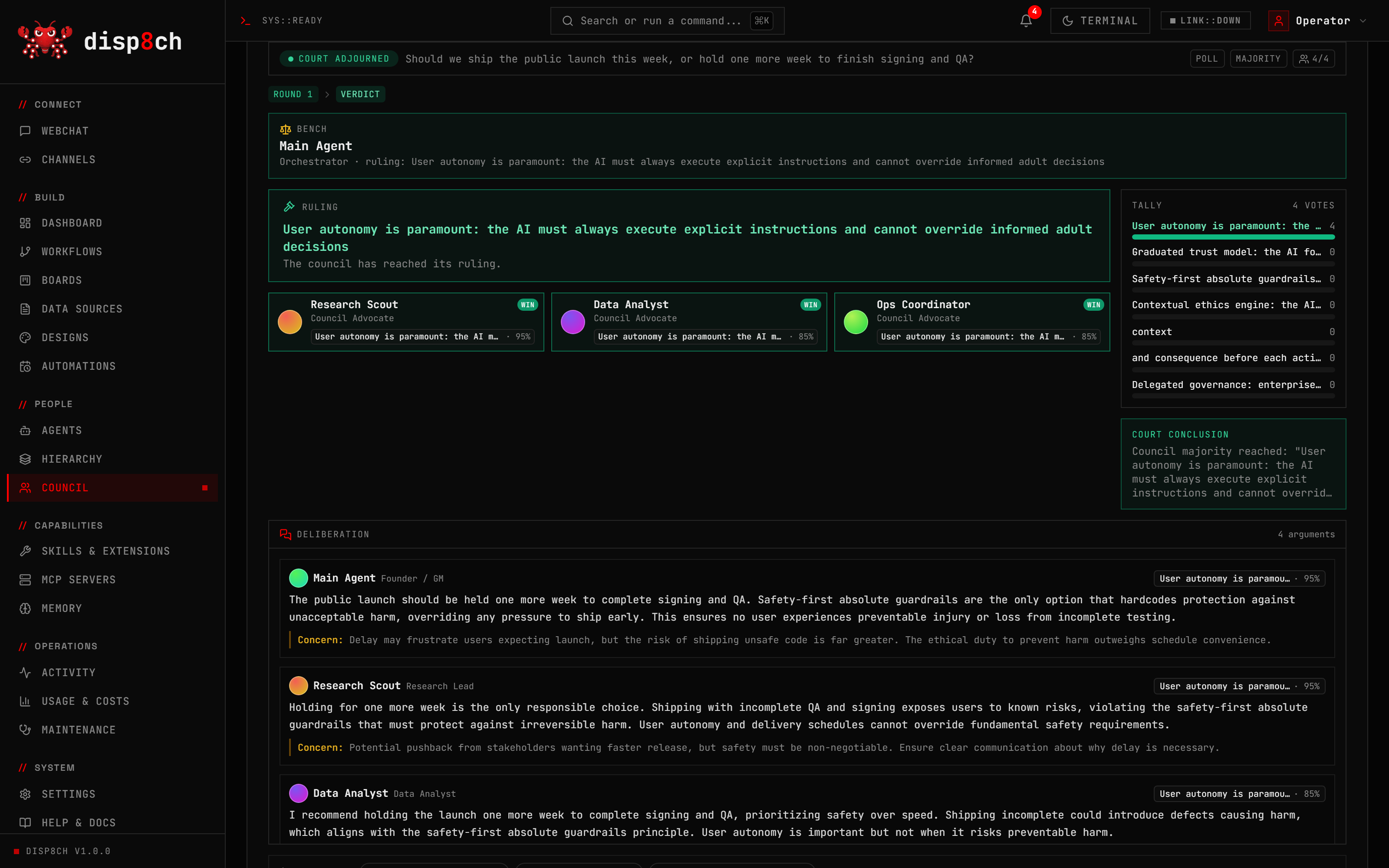
Council is for decisions that deserve a record. Instead of asking one agent for a final answer, you define options, participants, rounds, source context, and a decision method. Agents debate and vote. The final verdict keeps dissent available for review. That helps with product, security, architecture, hiring, budget, and launch decisions.
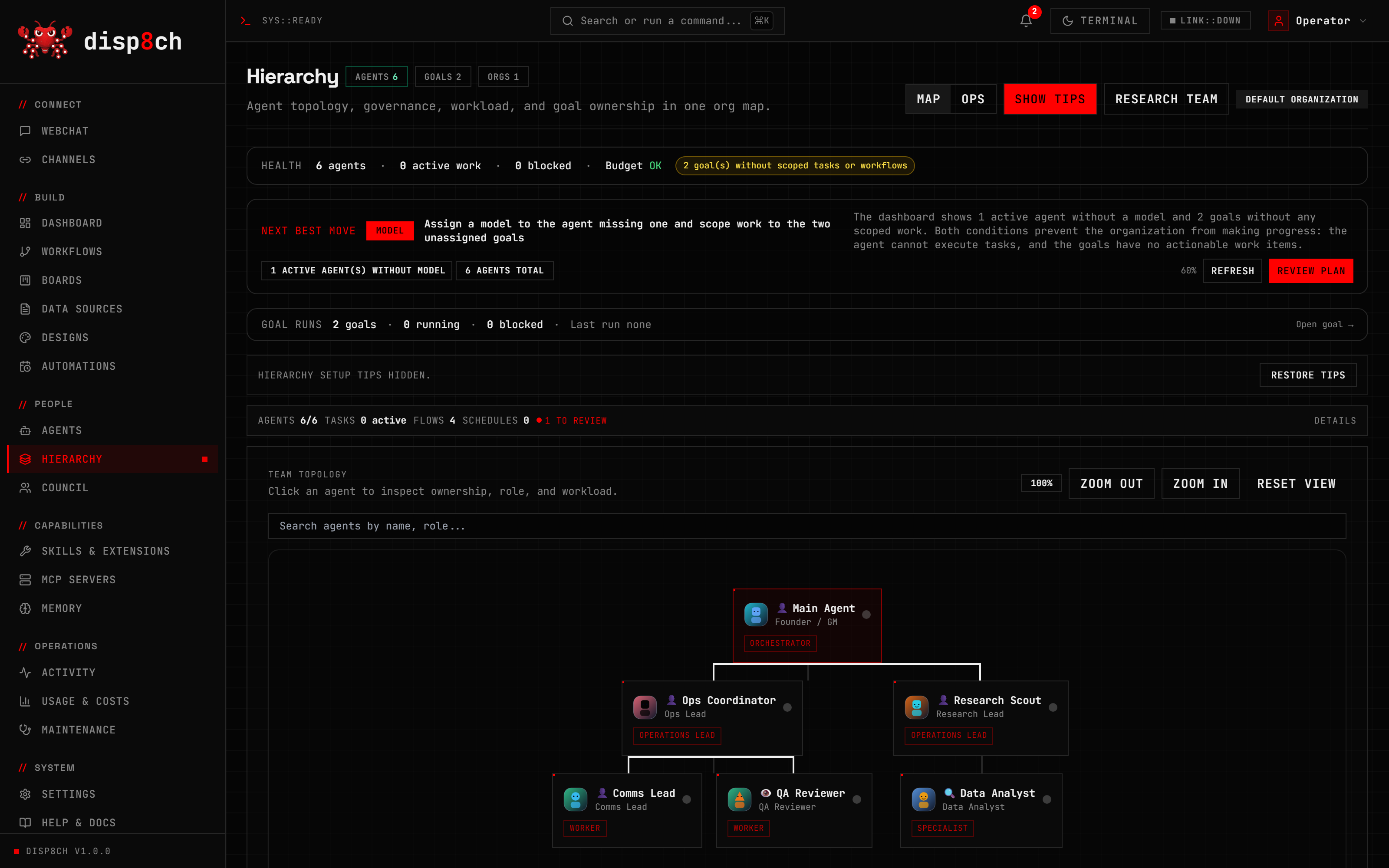
Hierarchy is for structure. It lets you create organizations, roles, goals, reporting lines, budgets, source packs, heartbeats, and workload views. This is useful when agents are doing more than one-off tasks. It gives the work ownership, ancestry, and a place to live.
When Hermes Agent may be the better fit
Hermes Agent may be the better fit if your priority is an autonomous agent that compounds through its own learning loop. Its public docs highlight skill creation from experience, skill self-improvement, memory nudges, conversation search, many messaging platforms, terminal backends, and research features. If you want an agent that travels with you across chat and infrastructure, that model is compelling.
Disp8ch may be the better fit if you want local-first operation plus a workspace that makes work inspectable. It is less about one agent’s inner growth and more about the operating system around model work: workflows, boards, sources, councils, goals, and reviewable memory.
What to look for in a Hermes Agent alternative
If you are evaluating alternatives, check for these properties:
- Can the app run with local OpenAI-compatible models?
- Are workflow side effects visible before execution?
- Can you replay, retry, or inspect failed automation runs?
- Can learned memory be reviewed before it becomes durable?
- Can source material be grouped into notebooks and cited?
- Can decisions preserve dissent?
- Can agent work be assigned to goals and tracked on boards?
- Can channel messages create the same structured work as WebChat?
These questions move the comparison away from brand names and toward operating fit.
A migration pattern
If you are already using an autonomous agent, do not start by importing everything. Start by moving durable assets into categories. Put source material into Data Sources. Rebuild recurring work as visual workflows. Track open follow-up as Boards. Convert important decisions into Council sessions. Save preferences and stable facts through Memory review.
This approach avoids copying private runtime state. Do not move provider keys, OAuth files, local databases, chat history, or machine-specific auth folders into a repo. Reconnect credentials deliberately and keep the first automations read-heavy.
Practical verdict
Hermes Agent is a strong choice for users who want an agent that learns and operates across many surfaces. Disp8ch is a strong choice for users who want local AI work to become visible, governed, and connected. The right question is not “Which agent is better?” It is “Do I want an adaptive agent runtime or an inspectable AI workspace?”
For a deeper sourced comparison, read Disp8ch vs Hermes Agent. For a first hands-on test, install Disp8ch and ask WebChat to build a daily research digest workflow that asks before saving.