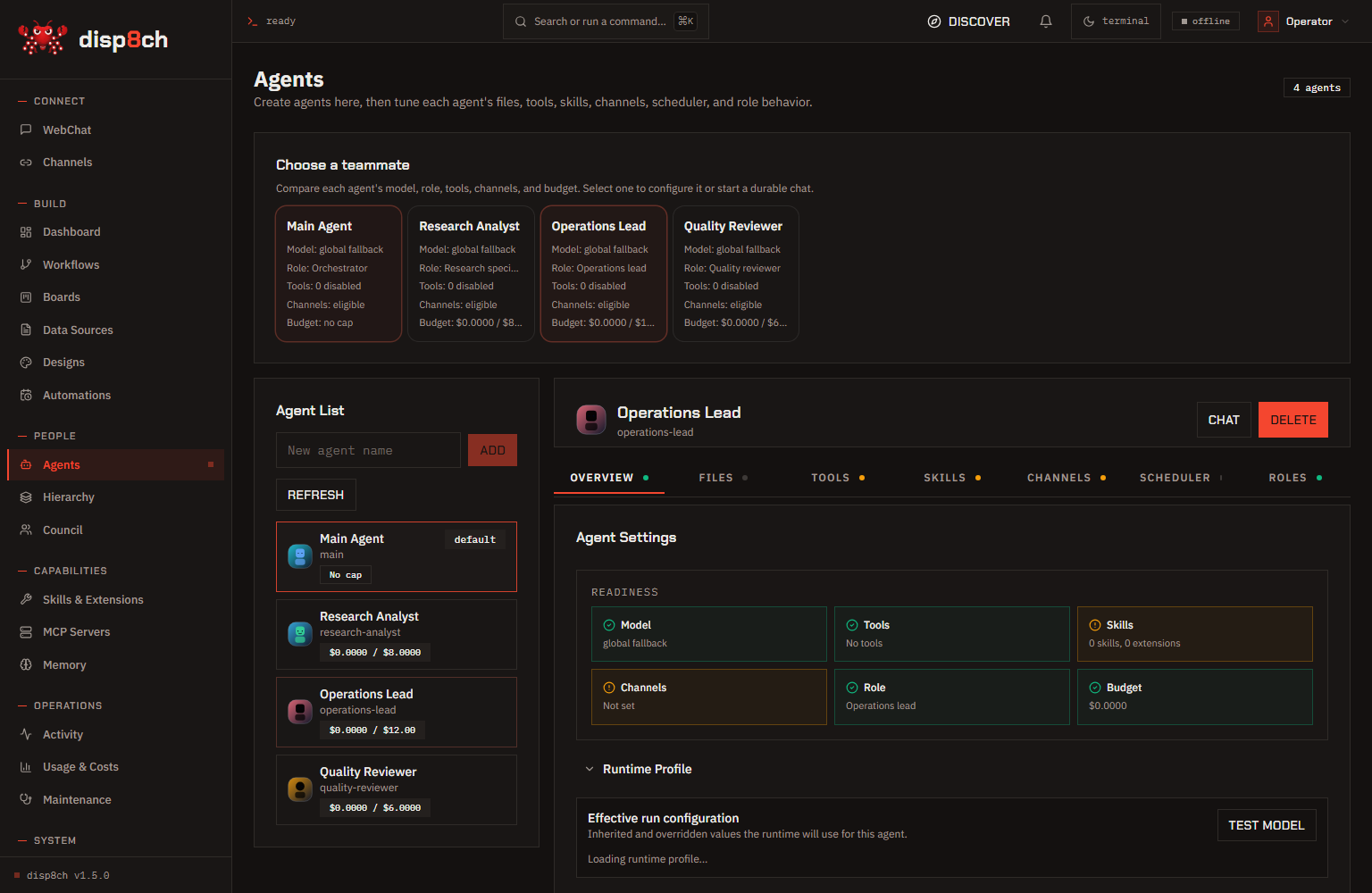
Disp8ch release notes covering contextual discovery, durable agent teammates, reviewable learning, grounded execution, supervised delivery, workflows, and local-first model control.
1.5.02026-09-02
Contextual discovery and durable teammates
Contextual discovery ranks relevant commands, tools, skills, agents, workflows, and setup actions from the current page, configuration, and stated intent; optional tips remain opt-in and dismissible.
Bot and teammate mode reuses Agents for configuration and WebChat for stable per-agent conversations, pinned teammate access, unread replies, and a safe inter-agent inbox instead of adding a duplicate primary tab.
Protected profiles and skills gain content-addressed revisions, rollback, stale-edit checks, and review-gated patches or support files.
Computer Use sessions can become inactive, review-only workflow drafts made only from successful observed actions, with approvals and secret placeholders preserved.
Long sessions use cursor pagination, MCP discovery is coalesced, extension runtimes dispose cleanly, and response cards expose bounded context and performance receipts.
High-certainty evidence tasks skip a redundant planning round, and response-only synthesis now streams directly; a focused Windows DeepSeek V4 Flash recheck reduced median time to first token by 38.6% across three repeated cases.
Windows verification passed TypeScript, the production build, 369 repository checks, 57 universal-agentic checks, 23 enhancement checks, and 16 responsive UI checks.
1.4.12026-08-01
Grounded execution and release hardening
Generic external-project requests now stay focused on the requested product unless the operator explicitly asks to inspect Disp8ch or its source.
Explicit response contracts preserve requested Return-section order and counts while keeping substantive analysis model-led and evidence-grounded.
Capability audits distinguish implemented, configured, registered, and callable tools, with implementation and dependency preflight before readiness is reported.
Credential redaction now covers final answers, logs, workflow traces, persisted execution data, and exports.
Hierarchy role resolution, Council roster stability, transcript citations, dynamic-run timestamps, asynchronous routes, and single-model supervised runs received focused reliability fixes.
Next.js, Sharp, the MCP SDK, and affected transitive parser and archive packages now resolve to patched releases; fresh npm and pnpm audits report zero known vulnerabilities.
Windows-native verification passed TypeScript, the production build, all 71 release suites, focused security, audit, routing, and synthesis checks, and the complete live Build Week flow.
1.4.02026-07-21
Supervised delivery from meeting to verified result
Supervised Runs resolve planner, implementer, and reviewer roles from Settings and Hierarchy, then freeze the exact agents and models into an acceptance contract with bounded repair and independent proof.
Consent-gated Live Sessions persist transcripts, editable speakers, timestamp-cited answers, structured findings, and Delivery Briefs that can enter existing Council, Board, Goal, Workflow, Memory, and supervised-run paths.
Files Projects adds allowlisted repository scanning, TypeScript structure, working-tree impact, cited source questions, exact line ranges, previews, and cross-tab delivery handoffs without weakening the App Files sandbox.
Design and Project outputs share one validation- and confirmation-gated publishing lifecycle with deployment status, revocation, and idempotent feedback-to-revision proposals.
Outcome-first Work Trails connect the achieved result to its original decision, ownership, proof, source, release, cost, and next action while preserving the full technical timeline.
Dependency hardening moved local models, workflow expressions, WhatsApp, Next.js, Drizzle, Nodemailer, Electron, MCP, and release tooling to maintained patched lines; npm and pnpm audits now report zero known vulnerabilities.
Windows-native verification passed TypeScript, the complete production build, and all 71 release suites.
1.3.22026-07-12
Cyberdeck interface and cross-surface reliability
Dashboard, WebChat, Workflows, Boards, Hierarchy, Council, Settings, and shared navigation now use one responsive Cyberdeck HUD system with warm ink and paper themes, accessible signal red, and reduced-motion support.
Council handles long participant names, concise option labels, comma-bearing choices, provider deadlines, mobile layouts, and reduced-motion court states without phantom options or votes.
Cross-tab WebChat keeps read-only research out of mutation plans, forwards real streamed tokens, preserves rich answers around concise artifacts, and bounds evidence-heavy work more predictably.
Workflow design now uses executable node fields, enums, graph paths, durable deduplication, retry controls, and explicit approval and delivery boundaries.
Loop conditionals execute only their selected branch per item, configured read-only failures can retry, and external sends remain non-retriable and approval-gated.
Windows-native verification covered the full release aggregate, focused routing and workflow regressions, clean-database live combinations, responsive UI checks, and production builds.
1.3.12026-07-06
Refactor and performance pass
Agent and role reads now use short-lived caches with explicit invalidation, reducing repeated database work during API calls and agentic turns.
Workflow, agent, role, and document list responses use compact summary payloads while full details remain available where they are needed.
Workflow templates, engine tool catalogs, and channel router built-ins were split into smaller modules without changing their public behavior.
Broad composition follow-ups preserve exact requested formatting without collapsing technical transformation requests into shallow rewrites.
The website now uses Astro image optimization, smaller social assets, font preloads, and one shared scroll handler.
Release verification covered lint, typecheck, builds, regression tests, live model scripts, API benchmarks, website checks, and paired comparison runs.
1.3.02026-07-03
Tab audit performance and UX
Workflow editor undo and redo is more reliable, with narrower render updates and memoized node styling.
Council failed model calls and unparseable responses no longer create phantom votes.
Shared client data cache dedupes concurrent first fetches, and DeepSeek V4 Flash cost estimates resolve correctly.
Workflows list cards load server-side summary rows by default, while full graphs are requested only when needed.
Chat markdown parsing, message rows, Design Studio previews, and hierarchy panels received focused performance improvements.
1.2.02026-06-30
Richer computer control, Design Studio editing, and notebook source work
Optional Computer Use gained bounded capture modes, exact app targeting, structured tokens, and approval-gated native actions.
Design Studio added an in-place assistant, selected-element editing, versioned patches, and better artifact refresh behavior.
Data Sources now separates the source library, notebooks, and global WebChat actions more clearly.
1.1.22026-06-28
Computer use, Kanban blocks, and Design Studio intake
Computer Use remains optional and off by default, with doctor accuracy and first-install opt-in support.
Boards gained typed block reasons, recurrence tracking, human escalation, and recovery actions.
Chat answers now avoid unsupported navigation, screenshot, and desktop-control claims unless matching tools actually ran.
1.1.12026-06-24
Workflow approval and memory scope
Workflow side effects are classified by a canonical effect model immediately before execution.
Approvals are hash-bound, one-time, durable, and tied to exact workflow versions, nodes, targets, and payloads.
Workflow memory can remain private to a workflow or be deliberately shared with an agent.
1.1.02026-06-23
Local model setup, MCP governance, browser navigation, and release quality
Hardware-aware local model recommendations became part of setup.
MCP discovery and execution gained consistent agent and organization scope.
Help and Docs gained permanent release history and stronger first-model guidance.
1.0.02026-06-23
Initial public release
Agentic WebChat, visual workflows, Boards, Hierarchy, Council, Data Sources, notebooks, local memory, skills, extensions, and MCP servers shipped together.
The first release focused on local-first operation, governance, workflow safety, and multi-agent visibility.